The Haitian Revolution / Revolisyon Ayisyen
Early in his explorations, Christopher Columbus came ashore on the Caribbean Island that would become dubbed Hispaniola, current day Haiti and Dominican Republic. Slavery was brutal in this part of the world. Disease and warfare killed many of the indigenous Taíno population, while survivors, including Africans, escaped, creating hidden communities in the mountains. The mountainous far west side of the island became a French colony in 1697, while the Spanish occupied the east. The enslaved African workforce produced sugar cane and coffee in both regions, creating the richest European colony at the time. When French landholders began to lose control of the area, in roughly the year 1789, the enslaved equaled over 87% of Haiti’s population.
1804 was a pivotal year in Haiti’s history. In this year, fifty-nine years before the issuance of the Emancipation Proclamation in the United States, slavery was abolished, and independence from France was declared. Widespread slave uprisings, bolstered by the mountains and forests of Haiti, brought freedom, creating the first free Black republic in the Americas.
Byen bonè nan eksplorasyon li yo, Kristof Kolon te vini sou Zile Karayib la ki ta vin rele Ispanyola, aktyèl jou aktyèl Ayiti ak Repiblik Dominikèn. Esclavaj te brital nan pati sa a nan mond lan. Maladi ak lagè te touye anpil nan popilasyon endijèn Taíno yo, pandan kèk nan sa ki te siviv yo — ansanm ak Afriken ki te esklav — te chape epi yo te fòme kominote kache nan mòn yo. Bò lwès zile a, ki gen anpil mòn, te vin tounen yon koloni fransè an 1697, pandan ke Espay te kontwole pati lès la. Travay fòse Afriken yo te itilize pou pwodwi kann ak kafe nan tou de rejyon yo, sa ki te fè koloni fransè a vin pi rich nan tout koloni Ewopeyen yo nan epòk la. Lè gwo pwopriyetè fransè yo te kòmanse pèdi kontwòl sou zòn nan, anviwon ane 1789, moun ki te esklav yo te deja reprezante plis pase 87% nan popilasyon Ayiti.
Ane 1804 se yon pwen tounan nan listwa Ayiti. Se ane sa a, swasanndis-nef (59) ane avan Proklamasyon Emansipasyon te fèt nan Etazini, esklavaj te aboli e endepandans te deklare kont Lafrans. Gwo leve kanpe esklav yo, ki te jwenn sipò gras ak mòn ak forè Ayiti, te mennen viktwa e libète, epi te bay nesans premye repiblik Nwa ki te lib nan emisfè sa a nan mond lan.
HAITIAN VODOU – SYMBOLS & LWAS / VODOU AYISYEN – SENBÒL AK LOA YO
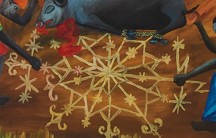
VÉVÉ
A very common symbol or visual element found at the heart of a Vodou ceremony is the vévé. It is usually drawn on the floor by an oungan (priest) or manbo (priestess), using flour or a mixture of cornmeal and ash. These symbols are a pictorial beacon used to call forth specific Haitian spirits called loa. Every loa has his/her own unique vévé, although regional differences have led to different vévés for the same loa. When in use for ceremony, these symbols are quite temporary and quickly disappear during the proceedings. The adaption of these symbols by artists and emblazing them on works of art and devotional objects helps to maintain and preserve the visual spiritual culture of Vodou.
Yon senbòl trè komen oswa eleman vizyèl yo jwenn nan kè a ak seremoni Vodou a se vèvè a. Yon senbòl oubyen eleman vizyèl ki trè komen nan kè yon seremoni Vodou, se vévé a. Anjeneral, se oungan (prèt) oswa manbo (prètès) ki trase l atè a, ak farin frans oswa yon melanj farin mayi ak sann. Senbòl sa yo se tankou yon siy vizyèl ki sèvi pou rele sèten lespri ayisyen yo rele lwa. Chak lwa gen pwòp vèvè pa li, menm si gen diferans rejyonal ki fè gen plizyè vèsyon vèvè pou menm lwa a. Lè yo sèvi ak vèvè sa yo nan seremoni, yo pa dire lontan yo disparèt byen vit pandan aktivite a. Lè atis adopte senbòl sa yo epi mete yo sou travay atistik oswa objè devosyonèl, sa ede konsève ak prezève kilti espirityèl vizyèl Vodou a.
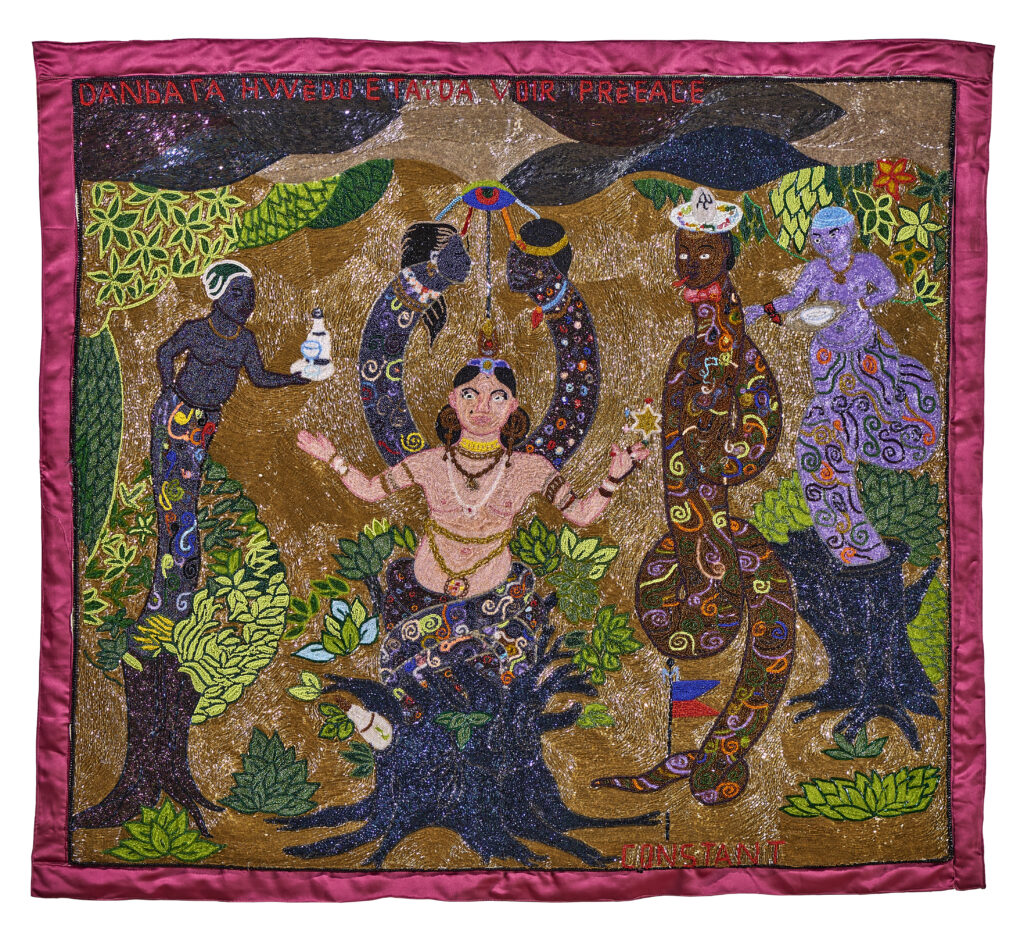
SNAKES / KOULÈV
The depiction of snakes and serpents is commonly found in Haitian Art. They may be represented as either a single snake or in a pair intertwined. In many cases, these symbols are a reference to the loa, Damballah. One of the most important of all the loa, the primordial creator of all life, and the first created by Bondye. Damballah is said to be the ancient source of wisdom and knowledge. He is often associated with the Catholic figure St. Patrick and depicted as a great white or black serpent with a white egg or holy chalice.
Pairs of snakes commonly represent Damballah alongside his female counterpart Ayida-Wedo. She is the great sky serpent or rainbow serpent and loa of fertility, rainbows, wind, water, fire, and snakes. Ayida-Wedo is also regarded as one of the ancient and significant loas. She is blended with the Catholic figure Our Lady of Immaculate Conception.
Reprezantasyon koulèv ak sèpan souvan parèt nan Atizay Ayisyen an. Yo ka parèt swa kòm yon sèl koulèv oswa kòm yon pè koulèv ki mare youn ak lòt. Nan anpil ka, senbòl sa yo fè referans ak lwa Damballah. Damballah se youn nan lwa ki pi enpòtan nan tout panteyon Vodou a, li se kreyatè prensipal lavi, e premye lwa Bondye te kreye. Yo konsidere Damballah kòm sous ansyen sajès ak konesans. Yo souvan asosye l ak sen Katolik Sen Patrix, epi yo reprezante l kòm yon gwo sèpan blan oswa nwa, ak yon ze blan oswa yon gode sen (kalis). Lè gen yon pè sèpan ki reprezante Damballah, li souvan parèt ansanm ak konpayèl li, Ayida-Wedo. Ayida-Wedo se gwo sèpan syèl la, oswa sèpan lakansyèl la. Se lwa fètilite, lakansyèl, van, dlo, dife ak koulèv. Li konsidere tou kòm youn nan lwa ki ansyen ak enpòtan anpil. Yo konn asimile li ak figi Katolik ki se Notre-Dame de l’Immaculée Conception (Manman Mari).
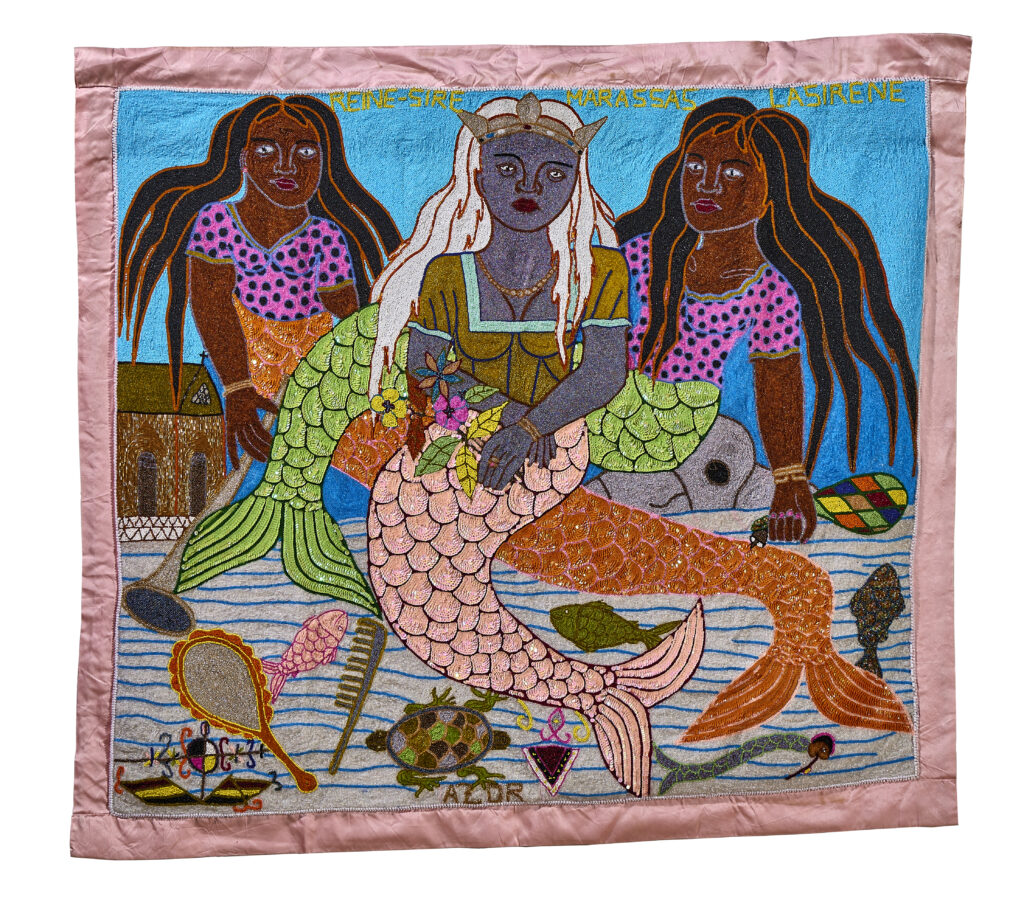
MERMAIDS / SIRÈN
There are several representations of mermaids within this exhibit. This mythical water creature can be found referenced in lore by Europeans, Africans and the indigenous Taíno peoples of the Caribbean. Within Haitian Vodou, depictions of a mermaid or mermaids are a direct reference to the loa, La Sirene. Half human female and half fish, La Sirene is a mysterious dual-natured spirit, who seduces and tricks while occasionally granting favor. She is associated with the sea, beauty, love, music, and wealth. Other symbols found in and around depictions of her include combs, mirrors, and a golden horn.
Gen plizyè reprezantasyon lasirèn nan ekspozisyon sa a. Bèt dlo mitik sa a jwenn referans li nan lejand ki soti lakay Ewòp, Afrik, ak pèp endijèn Taíno nan Karayib la. Nan Vodou Ayisyen, reprezantasyon lasirèn oswa plizyè sirèn se yon referans dirèk ak lwa La Sirèn. La Sirèn se yon lespri ki gen de nati — mwatye fi, mwatye pwason. Li gen yon mistè sou li, li ka sedui ak twonpe, men pafwa li bay favè tou. Yo asosye La Sirèn ak lanmè, bote, lanmou, mizik, ak richès. Lòt senbòl ki souvan parèt bò kote li oswa nan reprezantasyon li, se peny, miwa, ak yon kòn an lò.
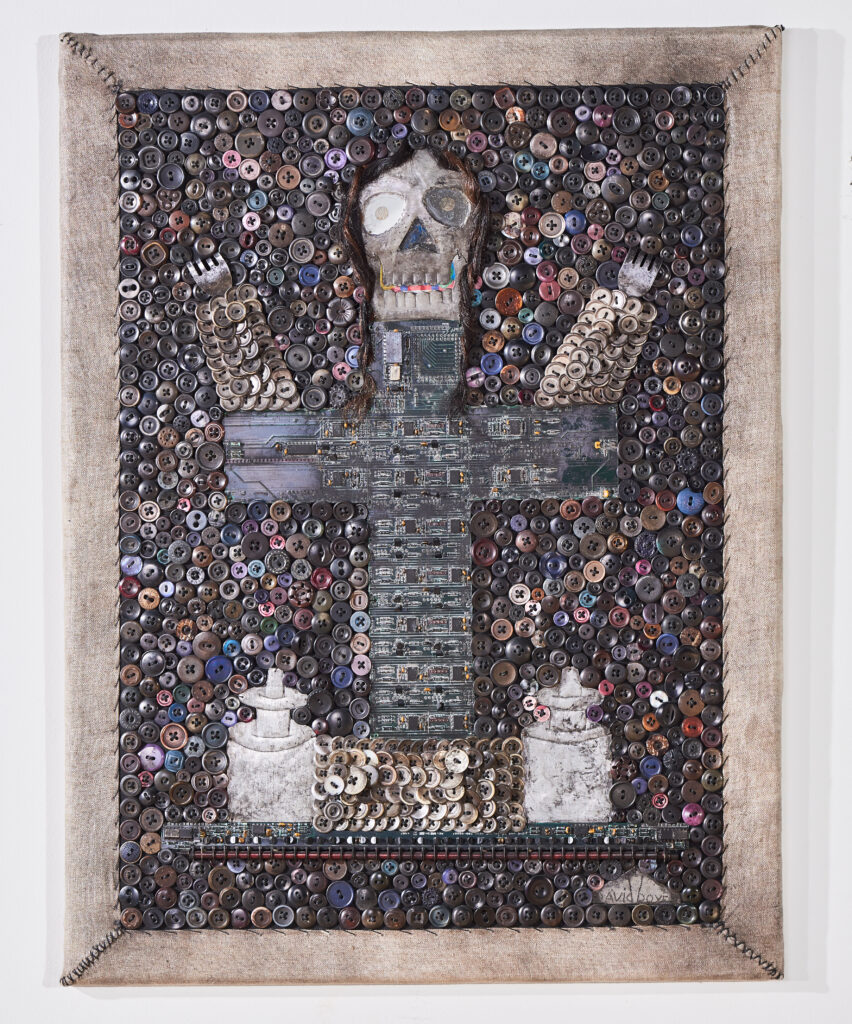
CROSSES / KWAZE
A ubiquitous symbol in Haitian art, the cross is not only a reference to Christianity, but rather has many points of reference and associations. It can represent the Christian cross, a crossroads, the four cardinal directions, the intersection of life and death, or the intersection of this world and the spirit world. This means the cross can also reference many different loas. The context and the additional symbols found around the cross often help viewers identify which loa is being channeled. The loa most frequently referenced using the cross is Papa Legba, the keeper, master, and guardian of the crossroads. He would be the first loa to be invoked in a ceremony to open the way to communicate between the natural and spirit worlds.
Kwa a se youn nan senbòl ki pi prezan nan Atizay Ayisyen. Li pa sèlman reprezante kwa kretyen an, men tou li gen plizyè lòt sans ak referans. Li ka senbolize kwa relijye, yon kwazman wout, kat pwen kardinal yo, kwazman ant lavi ak lanmò, oswa kwazman ant mond sa a ak mond lespri a. Sa vle di kwa a ka fè referans ak plizyè lwa diferan. Se kontèks la ak lòt senbòl ki antoure kwa a ki ede idantifye kiyès nan lwa yo ki ap manifeste. Lwa ki pi souvan asosye ak kwa a se Papa Legba. Se li ki gadyen, mèt, ak pòtè kle kwazman an. Li se premye lwa yo envoke nan yon seremoni pou l ouvri chemen pou kominikasyon ant mond natirèl la ak mond lespri a.
HEART & DAGGER / KÈ AK PONYA
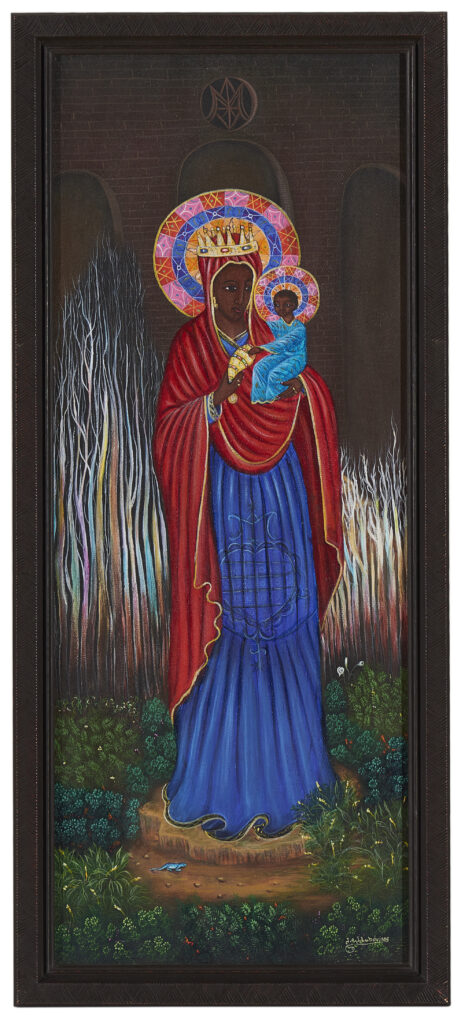
The heart, of course, is a reference to love, and within Vodou it could be a nod to the loa Erzulie Freda. She is the loa of love, sex, beauty, femininity, and luxury — the venus of Vodou. She is syncretized with the Catholic figure the Virgin Mary. The heart also makes a close parallel to another loa who is similar only in name, Erzulie Dantor. References to Dantor include a dagger piercing the heart. Dantor is the loa known for her fierce protection of women, children, and the neglected in society. She is the patron loa of Haiti, and the loa called upon during the Haitian Revolution. She is often syncretized with the Catholic figure, the Black Madonna of Czestochowa, who is represented as being darkskinned with scars on her face.
Kè a, jan nou ka imajine, se yon senbòl lanmou. Nan Vodou, li ka fè referans ak lwa Èzili Freda. Èzili Freda se lwa lanmou, seksyalite, bote, féminite, ak liks – li se tankou Venus nan Vodou a. Yo konn asimile li ak figi Katolik Vyèj Mari. Men, kè a tou gen yon lòt referans ki pre, men ki diferan: Èzili Dantor. Dantò se yon lòt lwa ki pa menm ak Freda malgre non yo sanble. Yo konn reprezante Dantor ak yon kouto ki ap pèse kè a. Èzili Dantò se lwa ki bay pwoteksyon ak kouraj pou fanm, timoun, ak tout moun sosyete a neglije. Se li yo konsidere kòm patwòn Ayiti, e se li yo te rele pandan Revolisyon Ayisyèn nan. Yo konn senbolize li ak figi Katolik “Vyej Nwa Czestochowa”, ki se yon Vyèj Mari nwa ki gen mak sou figi li.
Return to the Exhibition / Ekspozisyon