ISTWA SANT WATERLOO POU ATIZAY KOLEKSYON ATIZAY AYISYEN
The collection of Haitian artwork at the Waterloo Center for the Arts began in 1977 with a gift from local couple, Dr. and Mrs. F. Harold Reuling. They met artists and purchased artwork as they traveled in Haiti during their retirement years. Their interest became a passion, and they were compelled to share the beloved art with their community. As the curators at the Waterloo Center for the Arts learned about the artwork of Haiti, they in turn encouraged the Reulings to seek work by the most notable artists, featuring particular and unique subjects. Masterpieces showcasing the vitality and power of the Haitian experience entered the collection regularly.
At the same time, the curators sought assistance from collectors and scholars. Marilyn Houlberg and Ute Stebich were instrumental in aiding research, interpretation, and defining a direction for collection efforts. Over the collection’s growth, the museum has focused its efforts on filling in missing narratives and artists in an attempt to position itself as a champion of Haiti’s culture and art. Today, the collection holds over 2,000 objects and is recognized as one of the world’s largest publicly held collections of Haitian artwork.
The work is unique, colorful, and expressive. Artists in Haiti are inspired, among other things, by the heroic legacy of a slave uprising that established their country as an independent nation, free of slavery, in 1804. Residents of North and South America, as well as the Caribbean, can appreciate the uniqueness of this experience while also recognizing the common influence that African traditions, enslavement, and forced religious conversion conveyed to cultures where this history is shared.
Koleksyon zèv atizay Ayisyen nan Waterloo Center for the Arts te kòmanse an 1977 ak yon kado yo te resevwa nan men yon koup lokal, Doktè ak Madan F. Harold Reuling. Yo te rankontre atis e te achte zèv atizay pandan yo t ap vwayaje an Ayiti pandan ane retrèt yo. Kiryozite yo te vin tounen yon pasyon, e yo te santi yo oblije pataje atizay yo te renmen anpil ak kominote yo. Pandan konsèvatè yo nan Waterloo Center for the Arts t ap aprann sou atizay Ayiti, tou te arrive ankouraje Reuling yo pou chèche zèv atis ki pi remakab yo, ki prezante sijè patikilye ak inik. Sa ki fè Zèv ki montre vitalite ak pouvwa eksperyans Ayisyen an te antre nan koleksyon an regilyèman.
An menm tan, konsèvatè yo te chèche èd nan men kolektè ak entèlektyèl. Marilyn Houlberg ak Ute Stebich te jwe yon wòl enpòtan nan ede rechèch, entèpretasyon, ak defini yon direksyon pou efò koleksyon an. Pandan koleksyon an t ap grandi, mize a te konsantre efò li pou ranpli narasyon ki manke ak atis yo e pou eseye pozisyone tèt li kòm yon chanpyon kilti ak atizay Ayisyen. Jodi a, koleksyon an gen plis pase 2,000 objè e yo rekonèt li kòm pi gwo koleksyon piblik atizay Ayisyen nan mond lan.
Zèv yo inik, kolore, e ekspresif. Atis an Ayiti enspire, ase souvan, pa eritaj ewoyik soulèvman esklav ki te etabli peyi yo kòm yon nasyon endepandan, lib de esklavaj, an 1804. Rezidan Amerik di Nò ak Amerik di Sid, ansanm ak Karayib la, kapab apresye inikite eksperyans sa a pandan y ap rekonèt tou enfliyans komen ke tradisyon Afriken, esklavaj, ak konvèsyon relijye fòse te pote nan kilti kote istwa sa a pataje.
HAITIAN ART FORMS
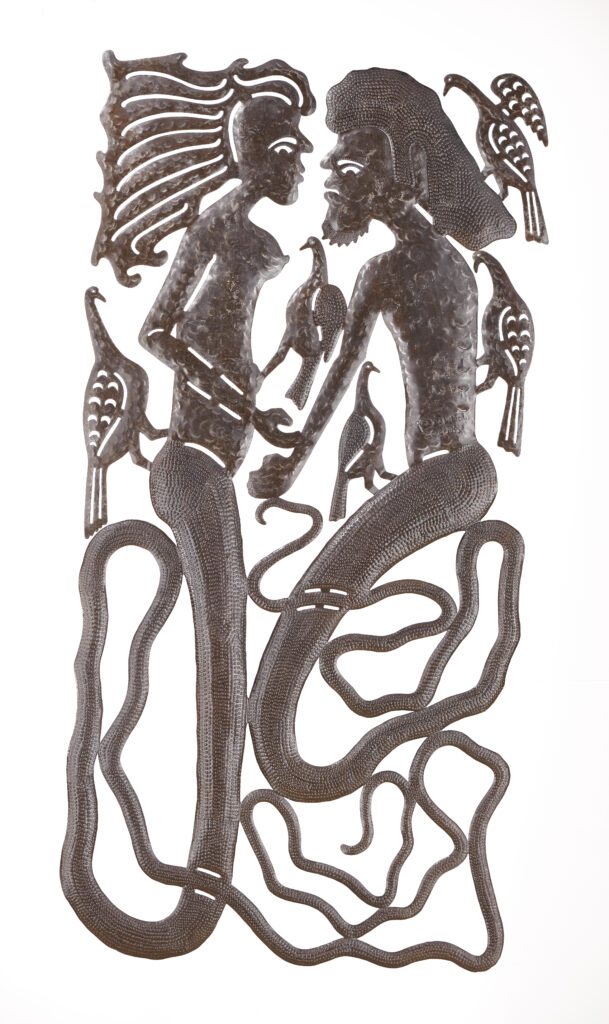
METALWORK / FÈ DEKOUPE
Renowned for their genius in transforming the discarded into dramatic works of art, Haitian artists discovered cast-off oil drums could be recycled into unique metal cut-outs.
This art form was probably first practiced by Georges Liautaud. He worked as a blacksmith for the Haitian-American Sugar Company, maintaining the railroad tracks. Liautaud became highly sought-after for the elaborate cemetery crosses he forged in his spare time. Liautaud likely began to use discarded oil drums as a material because they were plentiful and available for free. His work inspired others to experiment with the medium, and outstanding artists such as Murat Brierre, Gabriel Bien-Aime, and Serge Jolimeau emerged.
Haitian metal artists craft their works by hand, using simple tools. To prepare a drum, the artist or his apprentice removes the ends, which are then used for smaller sculptures. A vertical slit is cut along the length of the cylinder with a hammer and chisel. Next, the drum is stuffed with straw and paper and set on fire to burn off any paint or chemical residue. When the drum cools down, it is flattened. The metalworker climbs onto the drum’s body and uses all his weight and strength to open it up. The flattened drum becomes a rectangular sheet measuring approximately four by six feet. The metal is then hammered to make it softer and easier to cut. Any excess charred oil, paint, or rust is rubbed off before the artist draws his designs on the metal sheet using a piece of chalk. Then the figure is cut out with a hammer and chisel. The finished piece is signed by the artist and coated with varnish.
Most Haitian metal artists live and work in the Noailles district of Croix-des-Bouquets, situated on the outskirts of Port-au-Prince. The material’s symbolic significance appeals to these artists. Metal is considered sacred to Ogou, the Haitian loa of war, whose assistance helped lead the Haitian people in their fight to gain independence from the French.
Renome pou jeni yo nan transfòme sa lòt moun jete an bèl travay atistik, atis Ayisyen dekouvri ke yo te ka resikle barik lwil vid pou fè eskilti an fè ki pa tankou lòt.
Se Georges Liautaud ki sanble te premye moun ki pratike Atizay sa a. Li te travay kòm bòs fè pou Haitian-American Sugar Company (HASCO), kote li te okipe antretyen ray tren yo. Nan tan lib li, Liautaud te vin gen gwo repitasyon pou kwa simityè li te fè yo, ki te rich ak detay. Li sanble li te kòmanse sèvi ak barik lwil abandone paske yo te fasil pou jwenn e yo te gratis. Travay li te enspire lòt atis eseye mwayen sa a, e se konsa atis eksepsyonèl tankou Murat Brierre, Gabriel Bien-Aimé ak Serge Jolimeau te parèt.
Atis metal Ayisyen yo travay ak men yo, ak zouti senp. Pou prepare yon barik pou travay, atis la oswa apranti li koupe de bout barik la — yo sèvi ak bout sa yo pou fè eskilti ki pi piti. Yo louvri barik la ak yon fant vètikal sou longè silenn lan, yo sèvi ak mato ak dal. Apre sa, yo plen barik la ak pay ak papye epi yo mete l nan dife pou boule tout penti oswa rezidi chimik ki te ladan l. Lè barik la fin refwadi, yo fè l plat. Atis la monte sou barik la epi sèvi ak tout pwa ak fòs li pou l louvri l. Lè sa a, fè a tounen yon dra plat ki mezire anviwon kat pa sis pye. Yo bat fè a pou l vin pi mou e pi fasil pou koupe. Yo retire tout rès lwil boule, penti oswa rouy avan atis la trase desen li sou fè a ak yon mòso krèt. Apre sa, yo koupe fòm yo ak mato ak dal. Lè travay la fini, atis la siyen l epi li mete yon vèni pou pwoteje li.
Pifò atis metal Ayisyen yo ap viv ak travay nan katye Noailles, nan Croix-des-Bouquets, ki sou liy Port-au-Prince. Materyèl la gen anpil senbòl pou atis sa yo. Fè a se yon materyèl sakre pou Ogou, lwa lagè nan Vodou Ayisyen an, ki te ede pèp Ayisyen nan lit yo pou endepandans kont Lafrans.
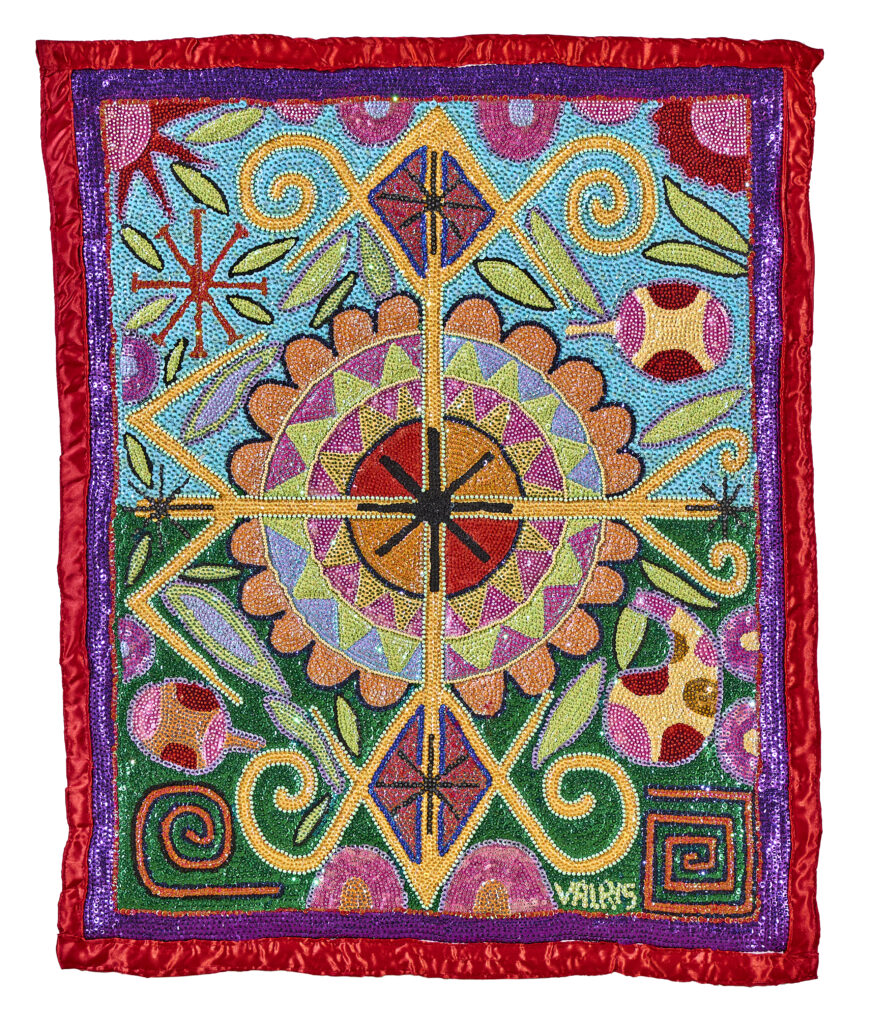
FLAGS / DRAPO
The arts of Haiti are indelibly tied to the religion of Vodou. Haitian Vodou, known and distorted through popular media as voodoo, is primarily a blend of African spiritual traditions and Catholicism. The term Vodou derives from the Fon word vodun meaning spirit, deity or mystery. The Fon brought their religion with them from Dahomey, now Benin, where it was combined with the religions of other African groups and synthesized with the Roman Catholic faith of the colonizers.
Traditionally, these stunning and elaborate beaded banners, known as drapo or drapeau, represent and honor Vodou deities or loas. The banners may be used in religious ceremonies and hung in altar rooms and, if consecrated, are considered to be sacred objects. In fact, many of the artists who make them are also religious leaders.
The visual representation of the various loas, each aligned with a particular aspect of life, will vary widely but are generally identifiable due to a common vernacular of associated images and symbols. For instance, each loa may be labeled expressly by name, may exhibit particular physical attributes, may be signified by the presence of specific colors, symbolic objects, images of their saintly counterparts drawn from Catholic prints, or maybe signified by special pictogram designs known as vévés.
More recently, these drapo have become recognized and appreciated as secular art objects (although many retain traditional forms and spiritual content) and many are now produced, not for the temple, but for the collector’s market. Consequently, this art form has seen revolutionary changes in stylistic variations, materials and techniques as new artists enter the arena, many of them bringing with them experience working in Haiti’s garment-making factories.
Atizay Ayiti yo konekte fon nan relijyon Vodou a. Vodou Ayisyen, ki souvan mal entèprete oswa karikature nan medya popilè kòm “voudou”, se yon melanj prensipalman ant tradisyon espirityèl Afriken ak Katolik. Mo “vodou” soti nan lang Fon, “vodun”, ki vle di lespri, dye, oswa mistè. Fon yo te pote relijyon yo soti Dahomey (jodi a Benen), kote li te melanje ak relijyon lòt gwoup Afriken epi li te vin senkretize ak lafwa Katolik kolonis yo.
Tradisyonèlman, banni bèl ak rafine sa yo ki fèt ak pèl, yo rele drapo oswa drapeau, sèvi pou onore ak reprezante divinite oswa lwa Vodou yo. Yo itilize yo pandan seremoni relijye, epi yo pann yo nan chanm lotèl. Si yo benyen (konsekre), yo vin tounen objè sakre. Anpil fwa, atis ki fè drapo sa yo se tou lidè relijye.
Reprezantasyon vizyèl chak lwa — chak gen lyen ak yon aspè espesifik nan lavi — ka varye anpil, men yo fasil pou rekonèt gras ak yon seri imaj ak senbòl komen. Pa egzanp, chak lwa ka make pa non li, ka gen aparans fizik tipik, ka idantifye pa koulè espesifik, objè senbolik, imaj sen Katolik ki asosye ak li, oswa pa vèvè (piktogram sakre) ki reprezante li.
Jounen jodi a, drapo sa yo ap jwenn rekonèsans tou kòm objè atistik sekilè (men anpil toujou kenbe fòm tradisyonèl yo ak sans espirityèl). Anpil nan yo pa fèt pou tanp ankò, men pito pou mache koleksyonè yo. Sa fè at sa a evolye anpil, ni nan estil, ni nan materyèl, ni nan teknik, sitou avèk nouvo atis ki rantre nan domèn nan, anpil ladan yo gen eksperyans nan faktori rad Ayiti.
Return to the Exhibition / Ekspozisyon