As we build our platform, we are creating a space for new scholarship on Haitian art. At the heart of the HADC project is ongoing collaboration with scholars from across disciplines. Our partners contribute critical insight throughout the process and share knowledge about Haitian art and visual culture. Through the HADC Digital Lakou™️, we have established relationships with a wide range of individuals and organizations. This digital “sandbox” invites close visual analysis and open discussion, offering new ways to engage with and appreciate Haitian art. The platform also draws on teaching and research traditions in library science, museum studies, cultural studies, and Black studies.
Through outreach and public engagement with the Digital Lakou™️ Sandbox, we envision the HADC website as a living resource that brings together research findings and digital analysis from many contributors. We aim to support the expanding field of Haitian art history by providing data and tools that enable deeper study, alongside new exhibitions and publications. By creating a shared space where scholars, art professionals, and the public can explore the richness and complexity of Haitian art, we hope to broaden how Haiti is understood in the contemporary world.
 Sandbox in Action
Introduction
A total of eighty-five (85) students registered for and participated in the course Museography and Exhibition Design during the Winter 2025 semester, which ran from January to May. That semester, the course was offered in collaboration with Dr. Petrouchka Moïse as part of the Haitian Art Digital Crossread (HADC) project. This collaboration serves as a prototype for structured engagement and is intended to support the development of a memorandum of understanding between the State University of Haiti and Grinnell College in Iowa.
The Course
The objective of this course is to enable students to understand the foundations and evolution of museography as both a technical practice and a methodological framework for creating museum exhibitions, as well as the basic principles of cultural heritage more broadly—its concepts, history, objects of study, and the professional practices associated with museum work. By the end of the semester, students are expected to develop a comprehensive understanding of museology as the global study of museums, examine their functions and missions in society, and situate their own field of intervention within this context while appropriately using the discipline’s core concepts and terminology.
The HADC model was selected for the course’s practical component because the Digital Lakou Sandbox provides a collaborative digital workspace focused on Haitian art within the HADC project. Moreover, HADC’s collaboration with the Waterloo Center for the Arts (WCA) and other partner institutions contributes to the development of a multi-institutional database on Haitian art. The participation of students from the State University of Haiti is therefore highly relevant: through their practical work, they can meaningfully contribute to enhancing the HADC Digital Lakou as part of this interinstitutional collaboration.
Internship/Practicum Structure
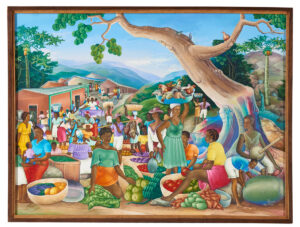
A total of 27 teams were formed, consisting of four members each. The teams were intentionally diverse, bringing together students from different disciplines (anthropology, art history, and archaeology). For the research assignment, each team was provided with a set of ten (10) images to examine and describe. Their tasks included conducting research on the artist and their style, techniques, or preferred themes; interviewing ten individuals to gather their personal descriptions of the images presented by the team; evaluating and analyzing the descriptive terms collected; determining which could be used for meta-tagging; and finally, reformulating the object descriptions accordingly.
Sample Outcome
Overall, all the students’ assignments exceeded the expectations of both the instructor and the HADC practicum instructor. However, one project stood out due to the team’s attention to detail and the richness and rigor of their image descriptions. Their analyses addressed a range of themes, including village life, leisure, ceremony, the Baron flag, winter scenes, and more.
For one of the images, the team reflected on the message conveyed by the artist, emphasizing the role of education as a tool for self-liberation, empowerment, and resistance. In interpreting this message, the team members perceived it as a genuine call to action, a guiding principle for transforming their own circumstances. They also situated the work within a critical perspective, highlighting the social inequalities produced by an educational system that, rather than bringing people together, tends instead to divide them.
Course Instructor
Jean Mozart Féron, Faculty Member of the UNESCO Chair in History and Heritage at the State University of Haiti (UEH), PhD (ABD) in Anthropology, Museum Evaluation Specialist